tutorials
Japanese: tokens and part of speech
Overview
This is a brief look at tokenization and part of speech assignment in Japanese.
Outcomes
- examine linguistic data and identify differences in how tokens are defined across languages (ex. Japanese vs. English)
- examine linguistic data and identify differences in how parts of speech are assigned across languages (ex. Japanese vs. English)
Prerequisites
Before starting this tutorial, ensure that …
- you are familiar with tokens and types
- you are familiar with parts of speech
Background
This section provides a (very) brief linguistic overview of Japanese.
Language classification
- Family: Japanese is a member of the Japonic languages family
- Morphological typology: The Japanese language is agglutinative. Increasingly complex words are formed by combining morphemes. The elements of these new words largely retain their original forms and meanings.
Word order
Canonical word order in Japanese is SOV (subject - object - verb):
私は寿司を食べます
| S | O | V |
|---|---|---|
| 私は | 寿司を | 食べます |
| 1SG-NOM | sushi-ACC | eat |
| 1 |
Written language
No whitespace between words used in writing
there is no clear word boundary like English (see the previous example)
Mixed writing system
-
- logographic system of approximately 50,000 characters
- Example: 食 in 食べます ('eat')
-
- syllabary for native words; all kanji can also be written (ambiguously) in hiragana
- Example: べ (IPA: /be/), ま (/ma/), and す (/su/) in 食べます ('eat')
-
- syllabary primarily used for foreign terms, loanwords, onomatopaeic expressions, and emphasis
- Example: ア (/a/), イ (/i/), and ス (/su/) in アイス ('ice cream' /aisu/)
Encoding, fonts, and text direction
Computers store text as numbers. A character encoding is a convention for deciding which numbers correspond to which writing symbols. Older encodings often worked well for one language, one operating system, or one region, but they made multilingual text difficult to exchange reliably. Unicode is the modern standard that gives software a shared inventory of characters across writing systems.
When we talk about writing systems, it is useful to keep three related ideas separate:
- Encoding: Unicode assigns abstract characters to code points. For example,
食has a code point, as doあ,ア, andA. - Fonts and glyphs: A font decides how a character is drawn. A font can make the same encoded character look handwritten, printed, old-fashioned, or modern without changing the underlying text.
- Layout and direction: Text is usually stored in logical reading order. Direction and visual layout are handled by a combination of Unicode character properties and higher-level layout systems such as HTML/CSS, word processors, terminals, or PDF renderers.
Japanese examples make these distinctions concrete. Japanese does not have the same uppercase/lowercase distinction used by Latin scripts, so operations like lower() and casefold() do not transform kanji, hiragana, or katakana in the way they transform English letters. Japanese also appears in multiple visual layouts: modern horizontal left-to-right text is common, but traditional vertical text is still widely used in books, signs, and historical materials. That visual layout is not the same thing as reversing the stored character order.
Python exposes some of these Unicode properties through unicodedata and string methods:
import unicodedata as ud
for character in "Aあア食":
    print(
        character,
        hex(ord(character)),
        ud.name(character),
        ud.category(character),
        ud.bidirectional(character),
    )
print("ABC".lower())
print("日本語".lower())
The details matter for NLP. Tokenization, normalization, case-folding, matching, sorting, and display are connected, but they are not the same operation. A pipeline that treats “character,” “glyph,” “token,” and “word” as interchangeable will eventually run into trouble.
How is it annotated?
There are a number of annotated corpora available for Japanese that include part of speech information. Let's examine how part of speech tags are assigned according to the universal dependencies annotation guidelines for the Japanese language…
Universal POS (UPOS) categorization
The Universal Dependency (UD) annotation guidelines for assigning part of speech tags for Japanese are described in the following paper:
| POS Tag | Explanations |
|---|---|
| ADJ | Adjective |
| ADV | Adverb |
| INTJ | Interjection |
| NOUN | Noun (except for nouns that can be used as VERB or ADJ) |
| PROPN | Proper noun |
| VERB | Verb (ex. 食べ "eat", 食事 "meal") |
| ADP | Case particles (が ga), adverbial particles (しか shika "only"), binding particles (は wa) |
| AUX | Auxiliary verb (食べ'た' "ate") |
| CCONJ | Conjunctions (また"also") |
| DET | Adnominal (あの"that") |
| NUM | Number |
| PART | Sentence-ending particles (か, "?", ), Suffix (本格'的' "genuine") |
| PRON | Pronoun |
| SCONJ | Conjunction particles (行っ'て' "go, and […]"), particle that attaches to a phrase and acts on the whole phrase (行く'の' "going") |
| PUNCT | Punctuation |
| SYM | Any punctuation except for PUNCT and X |
| X | Blank |
Example Sentence
蔵前国技館跡地は東京都に売却し、その売却益が…
| Original | 蔵前 | 国技 | 館 | 跡地 | は | 東京 | 都 | に | 売却 | し | 、 | その | 売却 | 益 | が |
|---|---|---|---|---|---|---|---|---|---|---|---|---|---|---|---|
| Romanization | Kuramae | kokugi | kan | atochi | wa | Tokyo | to | ni | baikyaku | shi | sono | baikyaku | eki | ga | |
| Gloss | Kuramae | national sport | building | site | (topic particle) | Tokyo | capital | (direction particle) | sell | that | selling | benefit | (object particle)) | ||
| Tag | PROPN | NOUN | NOUN | NOUN | ADP | PROPN | NOUN | ADP | VERB | AUX | PUNCT | DET | NOUN | NOUN | ADP |
| Detailed tag | Proper noun | Common noun | Suffix | Common noun | binding particle | Proper noun | Common noun | case particle | Verb ("-suru" can be attached) | Verb (cannot stand alone) | Punctuation - comma | Adnominal | Noun ("-suru" can be attached) | Noun ("-suru" can be attached) | Particle (case particle) |
| sent_id = dev-s49 |
Comment
Note that the UD annotation scheme for japanese treats the tensed element of a verb (past tense marker ta) is treated as a separate token from the verb root (ex. 食べた ('ate') → ["食べ", "た"]).
Verbal nouns are nouns that function as verbs when followed by an auxiliary verb (e.g. する suru meaning "do"). The stems of verbal nouns are tagged as verbs. For example, 売却 baikyaku ('sale') is tagged as VERB in the first instance in the previous example. As the second instance of 売却 (baikyaku) shows it as NOUN. Adjectival verbs.
Text normalization
Japanese does not have an upper case / lower case distinction. Emphasis is conveyed through other means (ex. use of katakana). Example strategies for text normalization in Japanese include …
- Spelling correction (standardization) and replacement of repetitions
- すげえええええええええ!!! ('awesomeeeeeeeee') すごい!
- Replacing rare kanji sequences with hiragana
- The hiragana syllabary is a more compact vocabulary of symbols than kanji
Challenges
Tokenization challenges
- No whitespace between words
- Mixed writing system: Use of katakana syllabary for emphasis or other stylistic reasons can make segmentation difficult
- agglutinative: long compounds and uncommon kanji can pose a challenge to segmentation strategies
POS tagging challenges
While certainly not unique to Japanese, ambiguity is a challenge for POS assignment. Instances of the same string may be assigned different POS tags in different contexts.
- For example, the particle の no can be a case marker, sentence-final particle, or a nominalizer
Misc
NOTE: Though it highlights unique linguistics challenges, this section is not strictly related to the Unit and is therefore optional.
Digitization and handwriting recognition challenges
The digitization of historic Japanese texts faces numerous challenges.
In addition to having a mixed writing system, the orientation of written text in Japanese is highly variable.
Japanese text can appear…
- left-to-right (LTR) horizontally
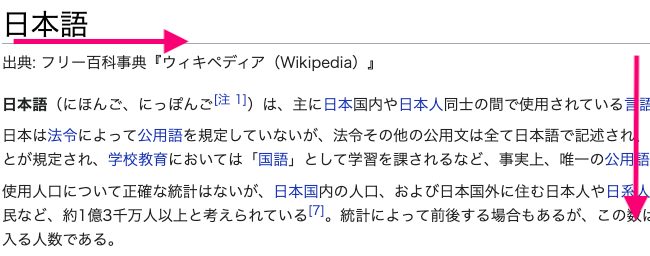
- right-to-left (RTL) and top to bottom (TTB) (ex. newspapers)
and even …
- left-to-right horizontally (uncommon and old style)
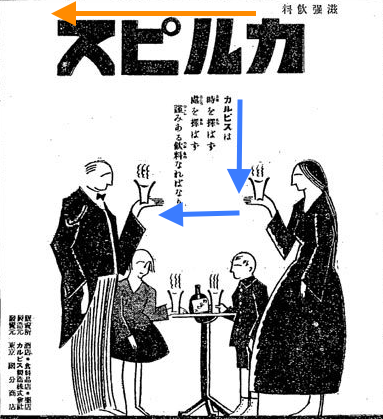 3
3
Older styles of cursive script bear little resemblance to modern handwritten Japanese:
- kuzushiji (old cursive style)
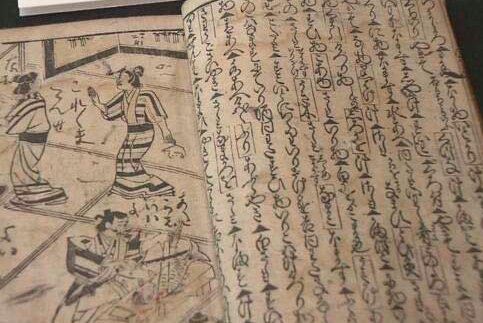
There is a vast trove of cultural information locked away in print media.
Next steps
Practice
- Using the provided linguistic data, identify some differences in how tokens are defined/delimited in English and Japanese
- What patterns do you notice (if any) for tokenizing Japanese text?
- Using the provided linguistic data, identify some differences in how parts of speech are assigned in English and Japanese
Additional resources
- WALS entry for Japanese
- Universal Dependencies for Japanese
- Japanese Universal Dependencies Corpora (in Japanese)
Datasets
Footnotes
- The bottom row of this table uses https://www.eva.mpg.de/lingua/pdf/Glossing-Rules.pdf
'I eat sushi' ↩
- See https://ja.wikipedia.org/wiki/%E6%97%A5%E6%9C%AC%E8%AA%9E ↩
- From https://ima.goo.ne.jp/column/article/3948.html (now defunct) ↩